The Scale of Consciousness.

9 emotional states that define how you perceive your life.
"I’d like to go to London. Can you show me the way?"
That’s not so easy if you don't know where I am, where London is, or what the path in between looks like, right? And yet, most of us walk through the world just as aimlessly when it comes to our emotions. We want to be happy and satisfied, but we don't know what we are feeling right now, nor how to get to where we want to be.
Our emotions influence every single moment of our existence. They determine our feelings, thoughts, behaviors, decisions, and actions—and thus every aspect of our lives. Despite this, most of us have never truly engaged with them.
Dr. David R. Hawkins, an internationally renowned spiritual teacher, author, and speaker on spirituality, consciousness research, and enlightenment, developed a Scale of Consciousness during his studies. He was able to assign specific emotions to individual levels on this scale.
This scale serves as a map to understand our current state, provides a vision of our goal—a state of inner peace, contentment, and happiness—and shows us the path we must take to get there.
The fundamental takeaway is this: The higher we are on this scale, the better the quality of our life—in all areas.
The Scale of Consciousness
Everything and everyone emits energy into their environment. This energy can be positive (high vibration) or negative (low vibration). We all experience this; we usually just don’t call it "energy," but rather a person's "vibe" or "aura." Intuitively, we recognize the difference between a positive person (friendly, honest, understanding) and a negative one (greedy, devious, hateful).
Think for a moment about Mother Teresa and then about Adolf Hitler. What do you feel inside? With Mother Teresa, I feel a loving and warm sensation, while Hitler feels cold and harsh.
Each of us has an individual energy that we broadcast, which can be placed on the scale from low to high vibration. Certain vibrational patterns correspond to levels of consciousness, which in turn find expression in specific emotions.
Dr. Hawkins developed both a detailed and an abbreviated version of the scale. For practical purposes, we will focus on the abbreviated form here. (For those who want to dive deeper, I recommend reading Power vs. Force by Dr. David R. Hawkins).
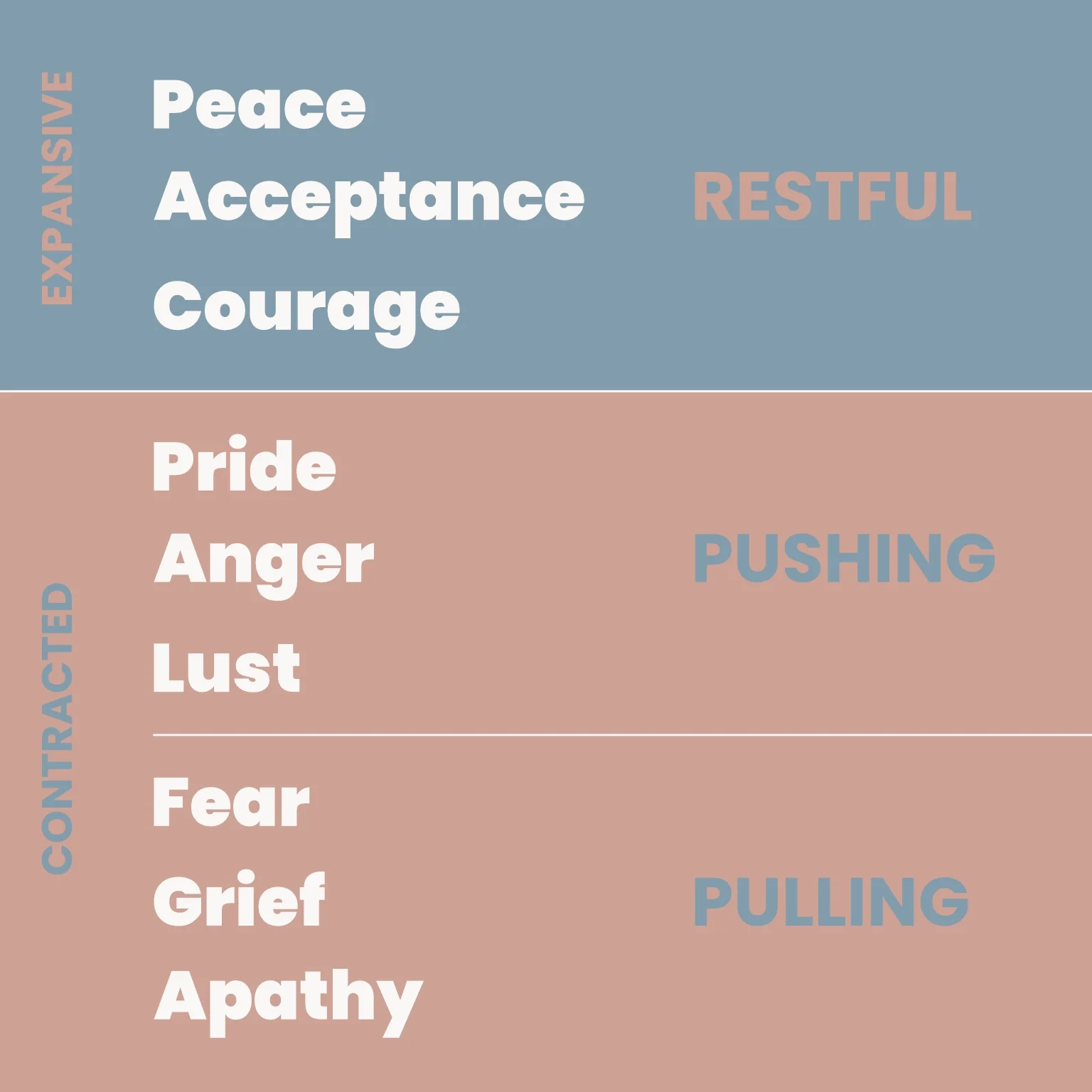
The nine emotions are presented from the highest vibration down to the lowest and are divided into three groups:
Expansive, Restful Energies.
Contracted, Pushing Energies.
Contracted, Pulling Energies.
Expansive, Restful Energies | The “Creator” Type
In these energies, we lack nothing. We feel connected to the world and live in harmony with ourselves and our environment. We are centered and balanced. No inner void exists that needs to be filled by something external. The world does not need to change for us to be happy and satisfied.
When we live in this state of consciousness, we do not create out of a need to fill a lack, but out of a sense of abundance and the joy of creation. We live with the awareness that everything is one and that our wishes and needs are met. Our presence alone attracts the people and situations necessary to achieve our goals. We no longer perceive obstacles and resistance as such; they are simply experiences and part of the process. The higher we vibrate, the more smoothly and easily we achieve our goals.
We feel no inner resistance toward our daily tasks. As a result, we work with ease and joy, are productive, and do not tire. In fact, the opposite happens—our activities give us energy.
Because we give off energy to those around us in these emotional states, people are drawn to us, enjoy spending time with us, support us, and follow us willingly. We give to others without expecting anything in return.
Peace: In this state, one experiences the world as perfect. Everything seems to happen effortlessly. We are blissful and feel a sense of oneness with the world. This is also referred to as a state of enlightenment. However, this state is very rare among humans.
Acceptance: This energy is free of inner resistance. In it, we are flexible, relaxed, and harmonious, considering the needs of others. We feel that life is good and that we are connected to everything.
Courage: When we live in courage, we feel that our ventures will succeed. We are determined, productive, enthusiastic about life, independent, and empowered. Effective action is possible. Here, we seek to create win-win situations for ourselves and our environment.
Contracted Energies
As soon as we fall below the level of Courage, we experience a sense of inner lack and separation from the world. The world must now meet our expectations for us to feel good. The lower our energy vibrates, the more we look for love, attention, and control externally to satisfy our own need for security and unity. In other words: The greater our inner lack, the more we "pull" emotionally and energetically on our environment.
This unspoken, constantly demanding attitude causes the world to distance itself from us (the more negative the energy, the greater the distance). This explains why we generally seek the company of positive, successful people and keep our distance from negative ones. In this sense, it is our own negative attitude that attracts further negative experiences into our lives, leads to failure, and makes it difficult to find friends or support.
Contracted, Pushing Energies | The "Fighter" Type
In high-vibration negative energies, we push against our environment to ensure we get what we need and want. Secretly, however, we doubt that our needs will be met. Therefore, we try to guarantee their fulfillment through manipulation, threats, force, or over-eagerness.
While we can achieve considerable success here, life is a constant struggle and competition. We assume there isn't enough for everyone. We only give to others to get something back—be it money, love, recognition, or control. Tasks are done because they have to be done, which costs a lot of energy and can lead to burnout. Once others see the selfish intentions behind our actions, they feel used.
Pride: In Pride, we feel better than others and believe our ideas are the best. We are driven by the need for success, recognition, the feeling of being special, and perfectionism. In this energy, we want to win at the expense of others (win-lose situations). It is the highest-vibrating negative energy, but it is still driven by the feeling of not being "good enough."
Anger: In Anger, we try to meet inner fear with external force and threats. We are explosive, irritable, embittered, unpredictable, and resentful.
Lust: In this energy, we never have enough. We want more of everything—more money, more possessions, more partners, or more pleasure. It is the feeling of "I must have this" and "Give it to me now." The inner lack is more visible here than in Pride or Anger.
Contracted, pulling Energies | The "Victim" Type
This group has a purely demanding character. We doubt ourselves and our value so much that we don't even believe we can get our needs met. As a result, we demand fulfillment from our environment without offering anything in return. We are completely self-focused and consumed by our suffering.
Dealing with us is exhausting, leading to a situation where only people in a similar state of mind tolerate our behavior. Others may feel pity or guilt toward us, but because we drain their energy, they usually leave quickly.
Fear: We see danger everywhere. We are hesitant, defensive, overly concerned with security, possessive, jealous, restless, and hyper-vigilant.
Grief: We feel helplessness, despair, loss, and regret ("If only I had..."). We feel like a loser and unable to go on, often hoping someone else will save us. (This also explains the heartache after a breakup—the feeling that we need the other person to be happy).
Apathy: Characterized by hopelessness and the feeling of "I can't" and "Who cares?" Poverty is common here. Unlike Grief, we don't even have the hope that someone else could help us. This energy is so heavy that we often feel numb.
A Little Mnemonic: AGFLAP & CAP
To remember the order of these emotions, you can use an acronym.
Apathy
Grief
Fear
Lust
Anger
Pride
(The negative energies)
&
Courage
Acceptance
Peace
(The positive energies)
Our "Vibe" vs. Consciously Experienced Emotions
From experience, we know we are never only in Apathy or only in Peace. Our mood changes constantly depending on what we experience. Our body stores all these energies; they exist as potential until a "trigger" activates them, and we experience them as an emotion.
Your "vibe" or "radiance" is the sum of all the energies stored in your body. The more you let go of low-vibration energies, the higher you vibrate in general.
In my next post, I will tell you how you can dissolve these emotions through "Letting Go," creating a life where you spend most of your time in the CAP emotions (Courage, Acceptance, Peace).
Live authentically, be great!